Markets Weigh Election Results Ahead of the Fed’s Next Move
Today’s blog is written by Chris Fasciano, chief market strategist at Commonwealth. He represents Commonwealth in various media appearances, advisor speaking events, and Commonwealth conferences. He also oversees and mentors a dynamic team of investment research analysts who specialize in equity and fixed income markets. Prior to this role, Chris spent 10 years as one of the firm’s portfolio managers, involved with asset allocation and fund selection. With a deep background in small- and mid-cap stock research, Chris is uniquely positioned to analyze the latest economic data and offer valuable insights on navigating today’s volatile markets. Chris Fasciano is a guest writer and is not affiliated with LPL Financial.
Investors spent much of last week assessing the implications of election results that gave Democrats control of the Senate, House, and several governorships. While votes are still being counted in some races, markets quickly shifted their focus to what the outcome could mean for policy and economic growth. Most of the debate was focused on artificial intelligence (AI) beneficiaries and whether the data center buildout will slow or face higher costs due to increased regulation. Understandably, economic data took a back seat.
While politics have dominated headlines, the Federal Reserve’s (Fed) next policy decision will not be based on election results. When the Fed chose not to raise rates in October, Chair Kevin Warsh mentioned that the period between that meeting and the December meeting was “information rich.” He may have been referring to the election and what it might portend for economic growth moving forward, but the economic calendar has plenty to offer during the six weeks between Fed meetings. So, any data points that give insights into inflation or jobs remain important as the market looks forward to the Fed’s next meeting. Consensus expectations remain that the committee will raise interest rates another 25 basis points (0.25%) when its meeting concludes on December 9.
Friday’s jobs report would seem to support this expectation. But there are several other factors that will go into the ultimate decision.
Jobs Creation Well Above Expectations
Friday’s jobs report came in well above consensus expectations. This continued a pattern evident throughout the year, with stronger-than-expected reports often followed by weaker reports and downward revisions, only to be followed by another month of unexpectedly solid job creation and upward revisions. That pattern makes it hard to hang one’s hat on a single data point. But there is no other way to describe the most recent report other than surprisingly strong across the board.
A Strong Rebound in Employment Data
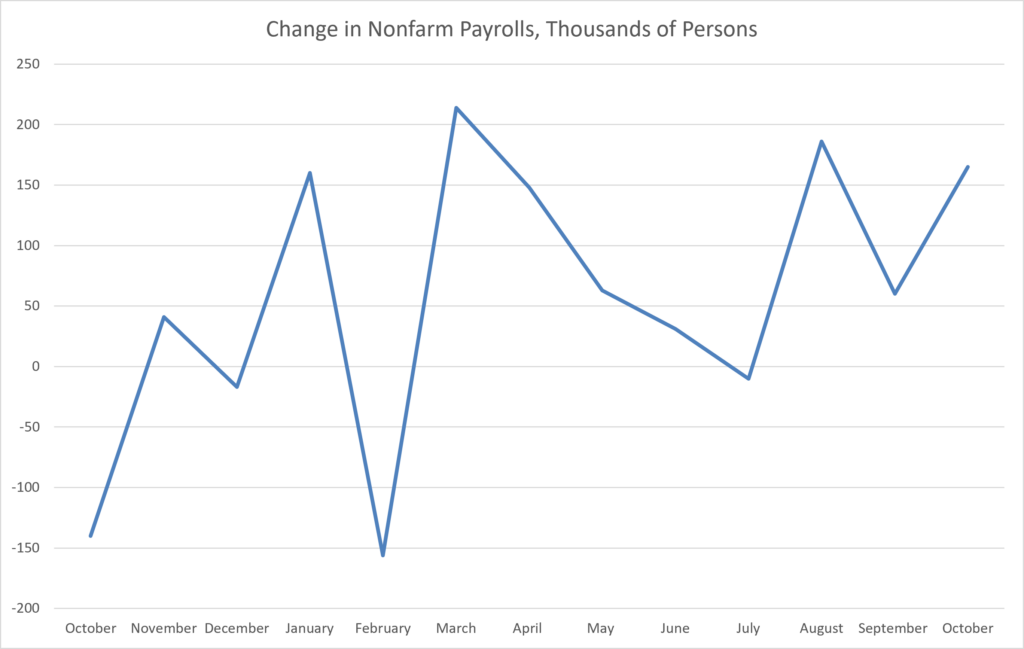
Source: LPL Research, U.S Bureau of Labor Statistics via the Federal Reserve Bank of St. Louis 11/6/26
The “A Strong Rebound in the Employment Data” chart illustrates that October’s nonfarm payrolls report showed the economy added 165,000 new jobs. This was well above consensus expectations of 70,000 new jobs. Further illustrating the resilient nature of the report, the previous two months were revised higher by a combined total of 84,000 jobs. Continued strong jobs creation was seen in the healthcare sector, which continues a multi-year trend, as well as a significant contribution from the professional and business services sector.
The unemployment rate also declined slightly and is now at 4.14%. This is a sign that the employment market remains tight, although not as robust as we saw in previous years. Wage growth rose 3.1% from a year ago, continuing to provide support for household incomes, although real wage gains remain modest. If the jobs market remains tight, wage growth should continue to improve moving forward.
On the surface this strength would support another rate increase in December, especially given what the Fed has been seeing in the inflation data.
Inflation Data is Up Next
This week will provide updates on both consumer and producer price inflation for the month of October. It is worth noting that the consumer report will not include a measure of year-over-year growth due to the government shutdown last year that limited the amount of data collected. However, inflation is expected to remain well above the Fed’s target of 2% for the foreseeable future. In addition, Chair Warsh has made it clear that the committee is focused on reducing inflation back to this target level. Inflation has remained above the Fed’s 2% target for more than five years, reinforcing policymakers’ commitment to returning price stability.
The combination of a strong jobs market and inflation over 3% argues for a further rate increase. But have market signals changed over the last couple of weeks?
How Much Weight Does the Fed Put into Future Potential Policy Shifts?
In the past, Chair Warsh has also said the committee should take cues from the market as it deliberates interest rate policy. Leading up to the election and in the days after America voted, the market seems to have been discounting slower growth and a settlement in the Middle East. West Texas Intermediate crude prices have declined from over $100 per barrel at various points this fall to just under $90 today. Some areas have begun to see relief in gasoline prices at the pump. In addition, the yield on the 10-year Treasury has declined from 5.36% in mid-October to under 4.90% today.
The market seems to be sending the message that they expect a slowdown in economic growth at some point in the intermediate term. AI-related investment, including spending on data centers, semiconductors, and cloud infrastructure, has become an increasingly important contributor to business investment and economic growth. While current spending plans remain robust, investors are evaluating whether future regulatory changes could alter the pace of that buildout given new Democratic governors in key states such as Texas, Georgia, and Ohio.
While the Fed does not react directly to election outcomes, policymakers will assess whether potential policy changes could affect future economic growth, labor market conditions, or inflation pressures. Depending on their conclusions, they might decide that they don’t need to raise rates in December and wait for additional data that would be available by the end of January when they are scheduled to meet for the first time in 2027.
Volatility Creates Opportunities
Sharp market swings often create investor uneasiness. Especially when it is focused on the stocks that have been the biggest winners over the last several years. However, history shows that market drawdowns create potential ways to enhance portfolios for the long-term. Just in the last couple of years, this pattern has played out around tariff announcements and the start of the war in the Middle East.
Potential policy changes will not have the same impact on all AI players. There will continue to be winners and losers. Meanwhile, it shouldn’t be lost on investors that other parts of the market are performing well given improved earnings growth and relatively attractive valuations. Alongside this, over the last month bonds have provided the ballast to portfolios that long-term investors have come to expect.
Volatility may persist as investors weigh the implications of election results, monetary policy, and the sustainability of the AI investment cycle. However, history suggests that periods of uncertainty often create the best opportunities for disciplined investors. In addition, diversified portfolios have generally been best positioned to navigate short-term dislocations while remaining prepared to participate when markets recover.
Important Disclosures
This material is for general information only and is not intended to provide specific advice or recommendations for any individual. There is no assurance that the views or strategies discussed are suitable for all investors. To determine which investment(s) may be appropriate for you, please consult your financial professional prior to investing.
Investing involves risks including possible loss of principal. No investment strategy or risk management technique can guarantee return or eliminate risk.
Indexes are unmanaged and cannot be invested into directly. Index performance is not indicative of the performance of any investment and does not reflect fees, expenses, or sales charges. All performance referenced is historical and is no guarantee of future results.
This material was prepared by LPL Financial, LLC. All information is believed to be from reliable sources; however LPL Financial makes no representation as to its completeness or accuracy.
Unless otherwise stated LPL Financial and the third party persons and firms mentioned are not affiliates of each other and make no representation with respect to each other. Any company names noted herein are for educational purposes only and not an indication of trading intent or a solicitation of their products or services.
Asset Class Disclosures –
International investing involves special risks such as currency fluctuation and political instability and may not be suitable for all investors. These risks are often heightened for investments in emerging markets.
Bonds are subject to market and interest rate risk if sold prior to maturity.
Municipal bonds are subject and market and interest rate risk and potentially capital gains tax if sold prior to maturity. Interest income may be subject to the alternative minimum tax. Municipal bonds are federally tax-free but other state and local taxes may apply.
Preferred stock dividends are paid at the discretion of the issuing company. Preferred stocks are subject to interest rate and credit risk. They may be subject to a call features.
Alternative investments may not be suitable for all investors and involve special risks such as leveraging the investment, potential adverse market forces, regulatory changes and potentially illiquidity. The strategies employed in the management of alternative investments may accelerate the velocity of potential losses.
Mortgage backed securities are subject to credit, default, prepayment, extension, market and interest rate risk.
High yield/junk bonds (grade BB or below) are below investment grade securities, and are subject to higher interest rate, credit, and liquidity risks than those graded BBB and above. They generally should be part of a diversified portfolio for sophisticated investors.
Precious metal investing involves greater fluctuation and potential for losses.
The fast price swings of commodities will result in significant volatility in an investor’s holdings.
This research material has been prepared by LPL Financial LLC.
Not Insured by FDIC/NCUA or Any Other Government Agency | Not Bank/Credit Union Deposits or Obligations | Not Bank/Credit Union Guaranteed | May Lose Value
For Public Use – Tracking: #1205984