What the “SaaSpocalypse” Can Teach Investors About Narratives, Fundamentals, and Time Horizons
October 15, 2026 | Thomas Shipp
Additional content provided by Tucker Beale, Senior Equity Research Analyst.
What the “SaaSpocalypse” Can Teach Investors About Narratives, Fundamentals, and Time Horizons
In this month’s edition of the Equity Research team’s flagship “Beyond the Numbers” publication, we discuss the potential threat that personal artificial intelligence (AI) agents, like Meta Platforms’ (META) recently released Muse, pose for consumer facing online businesses. In the note, we touch upon how markets got it wrong with a similar narrative earlier this year. In today’s market article, we dive deeper into what happened and what can be learned from the “SaaSpocalypse”.
Markets are forward-looking, but they are not always patient. Earlier this year, investors rapidly embraced the dramatic idea that AI coding tools could create many of the typical software applications businesses use, obviating the need for subscription-based “Software-as-a-service” (“SaaS”) licenses. The selloff in large “SaaS” stocks, which was quickly coined the “SaaSpocalypse,” showed how a plausible long-term risk can become an overpowering short-term narrative, and lead investors to “sell first and ask questions later”. The industry’s subsequent recovery offers a useful lesson for investors. In equity markets, narratives drive price in the short run, business value drive returns in the long run, and those two can diverge significantly, sometimes for months at a time.
The fear was easy to understand. If AI could write code, automate workflows, and let companies build their own applications, why would businesses continue paying for dozens of software subscriptions? By late February, that question had driven the software index down more than 25% for the year, even as AI stocks remained positive and the broader market was roughly flat. Investors were not merely discounting slower growth. They were entertaining the possibility that the industry’s economics had fundamentally changed.
But a compelling narrative is not the same thing as confirmed financial evidence. As earnings arrived, many leading software companies continued to exceed revenue expectations. Industrywide trailing-12-month revenue growth accelerated from 5.6% at the end of 2024 to 13.2% by the end of 2025, then reached approximately 17% to 18% during 2026. By October 9, the software index had recovered to a ~6.7% year-to-date gain. That still trailed the broader market and AI beneficiaries, but it was far removed from the extinction scenario implied by the early-year selloff. The exhibit “SaaSpocolypse Narrative Hammered Stock Prices Despite Strengthening Fundamentals” charts the software industry’s stock underperformance relative to the S&P 500 index and Goldman’s “US Broad AI” thematic index, followed by a chart highlighting the software industry’s accelerating sales growth.
“SaaSpocolypse” Narrative Hammered Stock Prices Despite Strengthening Fundamentals
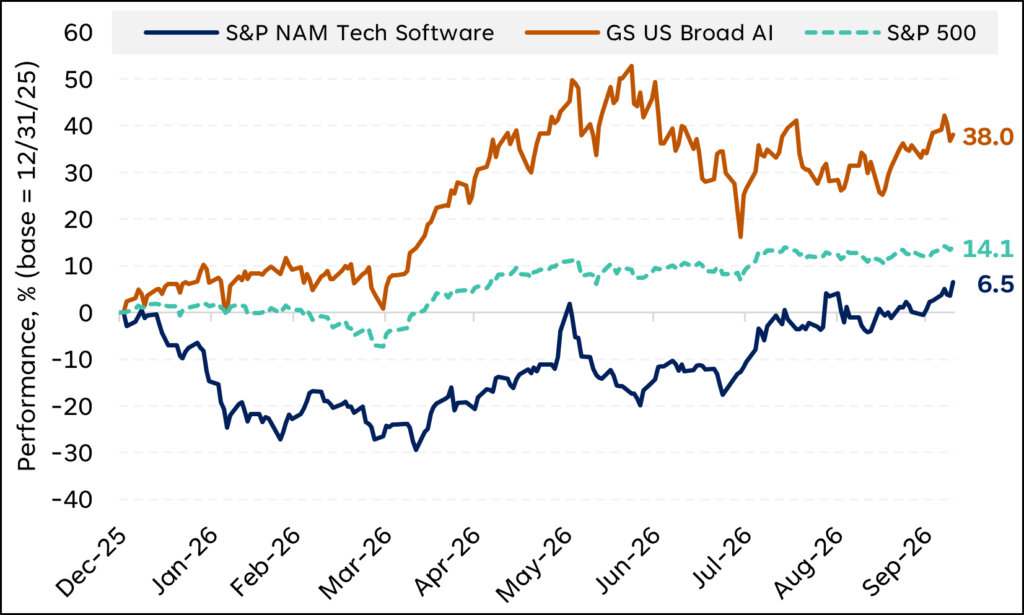
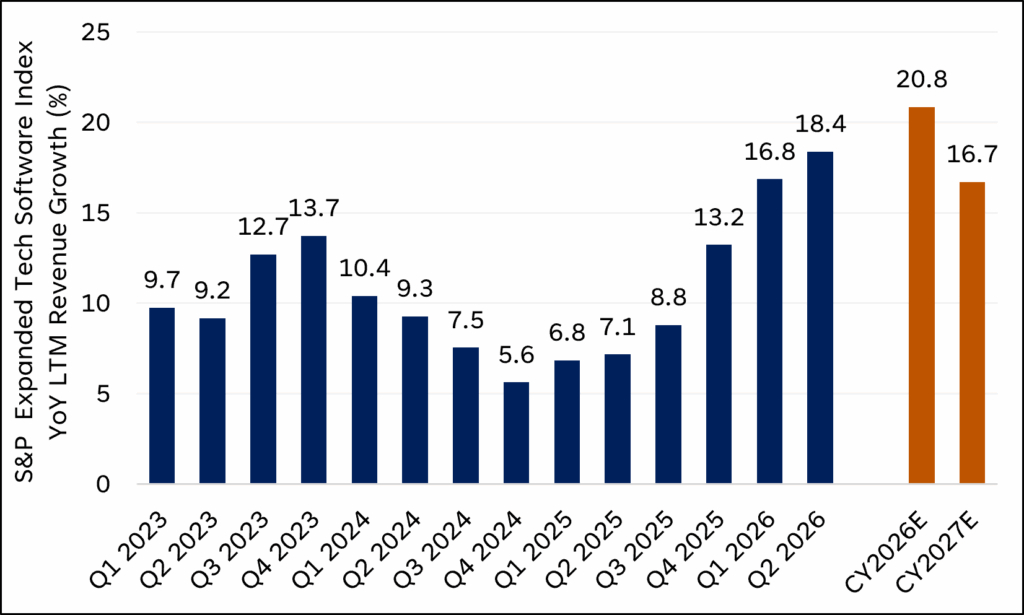
Sources: LPL Research, Bloomberg, Goldman Sachs, 10/09/26. SaaS industry performance and sales growth represented by the S&P North American Expanded Technology Software Index fundamentals. All indexes are unmanaged and cannot be invested in directly. Past performance is no guarantee of future results.
However, we are not suggesting investors ignore potential disruption. Some products could become commoditized, customer acquisition could get harder, and companies without a differentiated value proposition may face lasting pressure. The mistake is treating every company exposed to a disruptive theme as equally impaired.
This is where fundamentals can help investors distinguish a temporary dislocation from permanent damage. Are customers leaving, or are renewal rates holding? Is management reducing its long-term expectations? Most importantly, does the product remain embedded in customers’ operations, or can an AI-enabled alternative replace it quickly and cheaply?
A stock can fall for two very different reasons. In the first, investors become more pessimistic while the company’s cash flows, competitive position, and growth outlook remain broadly intact. That creates the possibility of a temporary valuation dislocation. In the second, the falling share price is correctly signaling deteriorating economics. Customers are leaving, pricing power is weakening, and the company’s addressable market is shrinking. “Buying the dip” will generally produce starkly different results in those two situations.
Investment time horizon also matters. Strategies with shorter timelines, strict risk limits, or a heavier reliance on price-based technical signals may respond to deteriorating momentum by selling an unfavored position and attempting to repurchase it after the trend stabilizes. That approach can limit exposure to a prolonged drawdown, but it also carries reinvestment risk.
Fundamental investors with longer horizons often react differently. If their estimate of a company’s long-term earnings power has not changed as much as its stock price, adding to a position on weakness may improve the prospective return. Rather than trying to identify the exact bottom, they may build a position gradually while monitoring evidence that would invalidate the thesis. The advantage is patience. The risk is mistaking a structurally impaired business for a temporarily misunderstood one.
This explains how two rational investors can respond to the same selloff in opposite ways. One may prioritize price trends and capital preservation; the other may emphasize valuation and long-term cash flows. Neither approach is automatically correct. Each depends on its time horizon, investment discipline, and ability to tolerate further volatility.
The “SaaSpocalypse” ultimately reminds investors that markets often price the story before the data can confirm it. Sometimes the story is right. Sometimes it is directionally right but financially exaggerated. And sometimes fear creates an opportunity because narrative moves faster than fundamentals. Successful investing requires differentiating price weakness from business weakness, remaining humble enough to accept being wrong, and flexible enough to change course when necessary.
Important Disclosures
This material is for general information only and is not intended to provide specific advice or recommendations for any individual. There is no assurance that the views or strategies discussed are suitable for all investors. To determine which investment(s) may be appropriate for you, please consult your financial professional prior to investing.
Investing involves risks including possible loss of principal. No investment strategy or risk management technique can guarantee return or eliminate risk.
Indexes are unmanaged and cannot be invested into directly. Index performance is not indicative of the performance of any investment and does not reflect fees, expenses, or sales charges. All performance referenced is historical and is no guarantee of future results.
This material was prepared by LPL Financial, LLC. All information is believed to be from reliable sources; however LPL Financial makes no representation as to its completeness or accuracy.
Unless otherwise stated LPL Financial and the third party persons and firms mentioned are not affiliates of each other and make no representation with respect to each other. Any company names noted herein are for educational purposes only and not an indication of trading intent or a solicitation of their products or services.
Asset Class Disclosures –
International investing involves special risks such as currency fluctuation and political instability and may not be suitable for all investors. These risks are often heightened for investments in emerging markets.
Bonds are subject to market and interest rate risk if sold prior to maturity.
Municipal bonds are subject and market and interest rate risk and potentially capital gains tax if sold prior to maturity. Interest income may be subject to the alternative minimum tax. Municipal bonds are federally tax-free but other state and local taxes may apply.
Preferred stock dividends are paid at the discretion of the issuing company. Preferred stocks are subject to interest rate and credit risk. They may be subject to a call features.
Alternative investments may not be suitable for all investors and involve special risks such as leveraging the investment, potential adverse market forces, regulatory changes and potentially illiquidity. The strategies employed in the management of alternative investments may accelerate the velocity of potential losses.
Mortgage backed securities are subject to credit, default, prepayment, extension, market and interest rate risk.
High yield/junk bonds (grade BB or below) are below investment grade securities, and are subject to higher interest rate, credit, and liquidity risks than those graded BBB and above. They generally should be part of a diversified portfolio for sophisticated investors.
Precious metal investing involves greater fluctuation and potential for losses.
The fast price swings of commodities will result in significant volatility in an investor’s holdings.
This research material has been prepared by LPL Financial LLC.
Not Insured by FDIC/NCUA or Any Other Government Agency | Not Bank/Credit Union Deposits or Obligations | Not Bank/Credit Union Guaranteed | May Lose Value
For Public Use – Tracking: #1192133