What Rate Hikes Mean for Wall Street and Main Street
September 22, 2026 | LPL Research
Today’s blog is written by Sam Millette, a portfolio manager on the Investment Management and Research team at Commonwealth. With the firm since 2013, he manages the Commonwealth fixed income research team, responds to advisor requests, and authors market research and commentary. Sam graduated from Tufts University with a degree in economics and is a member of the CFA Society Boston. Sam Millette is a guest writer and is not affiliated with LPL Financial.
Well, it finally happened.
Last week, after months of will-they-won’t-they speculation, the Federal Open Market Committee (FOMC) voted unanimously to hike the benchmark federal funds rate by 25 basis points at the conclusion of their September meeting.
This marks the first rate hike since 2023 and signals a shift to a more restrictive regime at the central bank. Markets and economists largely expected this result heading into the meeting as the Federal Reserve (Fed) remains laser focused on reducing inflation under newly appointed Chair Kevin Warsh.
In his post-meeting press conference, Chair Warsh indicated that the time was ripe for a rate hike due to stubbornly high inflation figures and an economic backdrop that remains otherwise healthy. Recent updates from the labor market showed continued low unemployment and a rebound in hiring in August, which supported the board’s decision to hike in September.
Looking forward, Fed members indicated that on average they anticipate one additional hike by the end of 2026 and likely no room for cuts until 2028 at the earliest. On a more positive note, the board also adjusted its forecast for economic growth higher in 2026 and 2027, signaling confidence in the health of the overall economy despite the headwinds created by persistent inflation.
For investors who have been keeping a close eye on the Fed over the past few months, the question is no longer whether or not the Fed will be hiking rates, but rather what rate hikes mean for portfolios and the broader economy.
Or to put it more succinctly, what does the recent Fed rate hike mean for Wall Street and Main Street?
Main Street
For consumers, rate hikes can have both positive and negative effects.
When the Fed hikes rates, borrowing costs for consumers and businesses rise, however, there are some important caveats to bear in mind concerning the type of debt that consumers tend to hold and the potential real world impact of higher rates.
For anyone carrying a credit card balance or using other common adjustable-rate loans, such as a home equity line of credit, rate hikes typically mean immediate higher borrowing costs. This is, of course, by design, as the Fed’s goal when hiking rates is to put a damper on economic activity through higher financing costs. These rising costs, in turn, cause businesses and consumers to cut back on spending in other areas and help tamp down spending growth and inflationary pressure.
While consumers can feel the sting from higher rates on their adjustable rate debt, fixed rate borrowers generally do not face the same challenge. Most mortgages in the U.S. for example, are fixed rate, long-term debt that is not directly impacted by rate hikes. For consumers locked into a fixed-rate mortgage, last week’s rate hike was largely a non-event for their monthly housing costs. This is especially true for those who were able to lock in relatively low mortgage rates in the post-pandemic period.
On the flip side, savers and those living off of investment income can benefit from higher interest rates. As the Fed hikes, higher yields are passed along to consumers through rising rates for savings accounts, CDs, and money market funds. This can be especially beneficial for retirees living off a fixed income, as higher yields on relatively safe investments can help stretch retirement savings and bolster household budgets.
Wall Street
Historically, rate hikes have impacted broad swaths of the investable universe, and this time is no different.
In his recent blog, “How Stocks Performed Historically After Initial Fed Rate Hikes?”, my colleague Jeff Buchbinder examined how stocks have performed after the first Fed rate hike in each cycle since 1994. He found that in five of the six most recent hiking cycles, stocks initially pulled back during the first month following the hike before rebounding and delivering positive returns over the subsequent 12 months.
While each rate-hike cycle is unique, this analysis forms a good starting point when trying to think about the potential impact of rate hikes on investor portfolios. Over the past few decades, rate hikes may have created a short-term headwind for stocks, but over the long run the impact was much more muted.
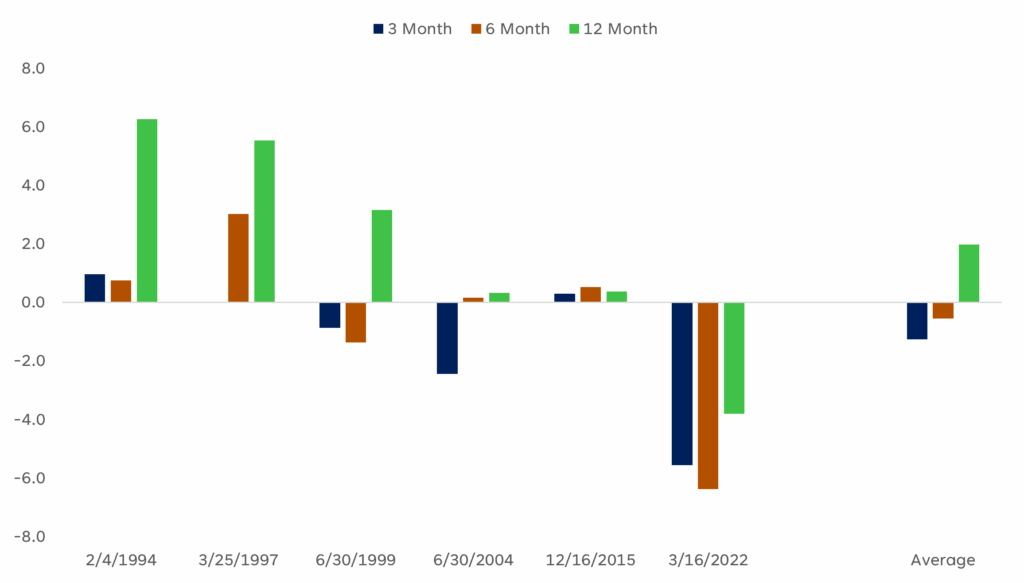
This is true as well for bonds. Taking the same time periods and looking at forward 3-, 6-, and 12-month performance for the Bloomberg Aggregate Bond Index, you will notice a similar pattern emerge.
Bloomberg Aggregate Bond Index Performance After First Rate Hike
Source: Bloomberg, LPL Research, 9/18/2026
Disclosures: All indexes are unmanaged and cannot be invested in directly. Past performance is no guarantee of future results.
On average, and in five of the six most recent hiking cycles, bond returns were positive a year after the initial rate hikes caused short-term headwinds.
Now the elephant in the room is the dreadful performance for the index following the initial rate hike in 2022. It’s important to keep in mind that the economic and market backdrop was very different in 2022 than it is now.
Back then, we were contending with headline consumer inflation above 9% and starting yields near 0% following years of pandemic-induced stimulus. That combination of factors caused the Fed to hike rates over 5% in less than two years in order to support price stability, which dramatically impacted both stock and bond valuations.
The challenges the Fed currently faces are less dramatic in scope as inflation has been hovering around 3.5% and starting yields are much higher, allowing bonds to absorb the negative price impact from rising rates more effectively.
While markets and economists expect further rate hikes from here, the scale is significantly less than back in 2022 and 2023. If we do experience a handful of modest rate hikes as currently anticipated, it would not be expected to cause similar levels of volatility that we saw in the last hiking cycle.
Encouragingly, bond markets took last week’s rate hike in stride, with the Bloomberg Aggregate Bond Index up modestly for the week. This was a sign that markets largely accepted the Fed’s reasoning and timing for the hike and are willing to be patient and monitor how Chair Warsh handles the current inflation challenge.
The Bottom Line
Historically, the overwhelming driver of total returns for fixed income investors has been income. Starting yields at current levels create opportunities for reinvestment and compounded growth for patient investors. While a rate-hiking cycle may present short-term headwinds for asset prices, over the long run the rising rate environment should present opportunities for fixed income investors to take advantage of as part of a well-diversified portfolio.
Important Disclosures
This material is for general information only and is not intended to provide specific advice or recommendations for any individual. There is no assurance that the views or strategies discussed are suitable for all investors. To determine which investment(s) may be appropriate for you, please consult your financial professional prior to investing.
Investing involves risks including possible loss of principal. No investment strategy or risk management technique can guarantee return or eliminate risk.
Indexes are unmanaged and cannot be invested into directly. Index performance is not indicative of the performance of any investment and does not reflect fees, expenses, or sales charges. All performance referenced is historical and is no guarantee of future results.
This material was prepared by LPL Financial, LLC. All information is believed to be from reliable sources; however LPL Financial makes no representation as to its completeness or accuracy.
Unless otherwise stated LPL Financial and the third party persons and firms mentioned are not affiliates of each other and make no representation with respect to each other. Any company names noted herein are for educational purposes only and not an indication of trading intent or a solicitation of their products or services.
Asset Class Disclosures –
International investing involves special risks such as currency fluctuation and political instability and may not be suitable for all investors. These risks are often heightened for investments in emerging markets.
Bonds are subject to market and interest rate risk if sold prior to maturity.
Municipal bonds are subject and market and interest rate risk and potentially capital gains tax if sold prior to maturity. Interest income may be subject to the alternative minimum tax. Municipal bonds are federally tax-free but other state and local taxes may apply.
Preferred stock dividends are paid at the discretion of the issuing company. Preferred stocks are subject to interest rate and credit risk. They may be subject to a call features.
Alternative investments may not be suitable for all investors and involve special risks such as leveraging the investment, potential adverse market forces, regulatory changes and potentially illiquidity. The strategies employed in the management of alternative investments may accelerate the velocity of potential losses.
Mortgage backed securities are subject to credit, default, prepayment, extension, market and interest rate risk.
High yield/junk bonds (grade BB or below) are below investment grade securities, and are subject to higher interest rate, credit, and liquidity risks than those graded BBB and above. They generally should be part of a diversified portfolio for sophisticated investors.
Precious metal investing involves greater fluctuation and potential for losses.
The fast price swings of commodities will result in significant volatility in an investor’s holdings.
This research material has been prepared by LPL Financial LLC.
Not Insured by FDIC/NCUA or Any Other Government Agency | Not Bank/Credit Union Deposits or Obligations | Not Bank/Credit Union Guaranteed | May Lose Value
For Public Use – Tracking: #1179184