Adjusting Free Cash Flow to Reflect True Owner Economics
Thomas Shipp | Head of Equity Research
Last Updated: September 03, 2026
Free Cash Flow Is a Starting Point, Not the Finish Line
In last week’s Beyond the Numbers, we made the case that free cash flow deserves a prominent place in investors’ valuation toolkits. Earnings can provide a useful measure of profitability, but free cash flow (FCF) gets closer to the central economic question: How much cash does a business generate after funding the investments required to operate and grow?
Capital requirements are rising alongside the cost of capital, and investors are paying closer attention to whether reported growth is translating into cash that ultimately accrues to owners. Our analysis found that FCF yield has historically been a more effective value factor than earnings yield or book yield. We also showed how the rapid increase in artificial intelligence infrastructure spending has created a widening gap between earnings and FCF for the hyperscalers.
There is an important follow-up to that discussion, however. Namely, reported “headline” FCF is not the same as economic free cash flow and therefore requires closer scrutiny.
The Headline Number Can Be Misleading
The most common definition of free cash flow is straightforward: Cash flow from operations minus capital expenditures.
This definition is simple, widely available, and generally more difficult to manipulate than an earnings measure. Yet it is still shaped by accounting classifications that may not fully reflect how a business creates value or consumes capital.
This is where fundamental analysis becomes important. A thoughtful analyst does not merely pull FCF from a data service and apply a multiple. The analyst asks what is included in the number, what is missing, and whether the reported cash flow is truly available to the company’s ongoing owners.
Our thinking here has been influenced by the work of Michael Mauboussin, who is widely respected within the investment community for his work connecting competitive strategy, returns on capital, and valuation. His research on this topic emphasizes that financial statements are organized according to accounting rules, while investors are ultimately interested in the underlying economics of the business. Reclassifying certain items can provide a clearer picture of operating profitability, reinvestment, and financing, even when total cash does not change.
For a business analyst, three areas deserve particular attention.
Stock-Based Compensation Is Still Compensation
Under GAAP (Generally Accepted Accounting Principles) accounting rules, stock-based compensation (SBC) expense is recorded on the income statement, reducing net income and earnings per share (EPS). This non-cash expense is then added back when companies reconcile net income to cash flow from operations because it does not involve an outlay of cash. This reconciliation can make a real compensation expense appear “free”.
The thought process here is that employees provide a service and receive something of value in return. Economically, the company can be viewed as issuing equity and using the proceeds to compensate employees. Carrying this logic through to an adjusted cash flow statement, it makes sense to categorize SBC as a financing activity as opposed to an operating activity. Existing shareholders bear the cost through dilution, or the company uses cash to repurchase shares to offset that dilution. In the latter case, a supposedly non-cash expense eventually becomes a very real cash outflow. The analytical mistake is adding SBC back to cash flow while ignoring the associated dilution.
Leases Are Another Form of Investment
A company acquiring an asset typically has a choice between buying it and leasing it. Economically, both decisions provide the company with the use of a productive asset. Yet the related cash flows can appear in different sections of the financial statements.
For analytical purposes, lease-financed asset purchases should generally be considered alongside conventional capital expenditures. Otherwise, two businesses with similar assets and operations can report different free cash flow simply because one buys its assets while the other leases them. Moving lease-related investment into the capital spending calculation can produce a more comparable view of reinvestment across companies.
Intangible Investment Requires Judgment
Existing accounting principles were largely designed for an economy built around physical assets. A factory or piece of equipment is capitalized and depreciated over time. Spending on research and development (R&D) such as software development, employee training, brand building, or customer acquisition, is generally expensed immediately, even when management expects it to generate benefits for several years.
This accounting treatment mismatch creates headaches for analysts, who are not beholden to stated reporting rules when attempting to underwrite the value of a business. Treating all R&D as a recurring operating cost may understate current profitability and investment, while treating all of it as a long-lived asset may be too generous.
The appropriate answer depends on the company and industry. Analysts must estimate which expenditures are required to maintain current operations and which represent discretionary investment intended to produce future growth. They must also make a reasonable assumption about the useful life of that investment. Unlike subtracting SBC, capitalizing intangible expenditures may increase adjusted operating cash flow while also increasing measured investment. Properly constructed, the adjustment changes the portrayal of profitability and reinvestment rather than magically creating additional value.
Software Provides a Useful Case Study
These adjustments matter most in industries where the gap between accounting presentations and economic reality is especially wide. Software is a good example. Companies in the industry often combine relatively low physical capital requirements with significant stock-based compensation and substantial investment in internally developed intangible assets.
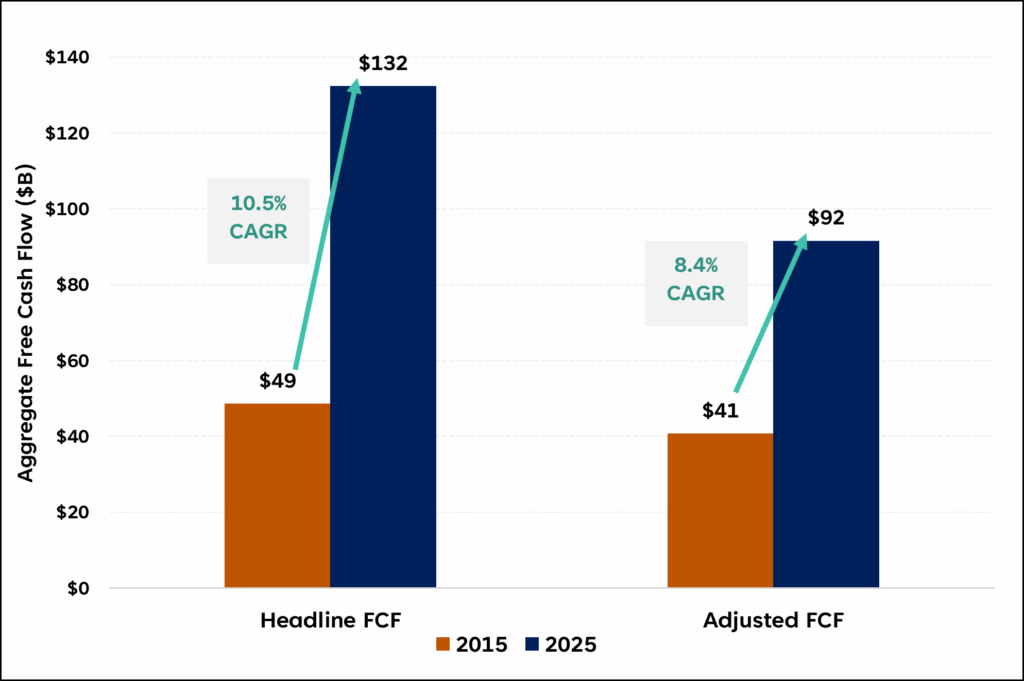
Our accompanying exhibit compares reported and adjusted free cash flow for the software industry (measured using the MSCI USA Software Index) from 2015 through 2025. Reported free cash flow increased from approximately $48.6 billion to $132.3 billion, representing a compound annual growth rate of about 10.5%. After deducting stock-based compensation, adjusted free cash flow increased from approximately $40.8 billion to $91.6 billion, or roughly 8.4% annually. That difference of about two percentage points per year may not sound dramatic, but compounded over a decade, it produces a considerably different assessment of cash flow growth.
Software’s Adjusted Free Cash Flow Growth Trails the Headline Number
MSCI USA Software Index reported and adjusted free cash flow, 2015 and 2025; adjusted FCF deducts stock-based compensation
Source: LPL Research, Bloomberg 09/01/26
Disclosure: Past performance is no guarantee of future results. All indexes are unmanaged and can’t be invested in directly.
The point is not that reported FCF is wrong. Nor is it that every adjustment should mechanically reduce the number. For example, had we adjusted the software industry FCF to capitalize intangible investments, as previously outlined, which are recorded as R&D expenses as incurred on the income statement, the adjusted FCF would likely increase from our SBC- adjusted figure. The point is that free cash flow is an analytical concept, not simply a line item to be accepted without question.
Last week, we concluded that intrinsic value is ultimately paid in cash. The companion lesson is that investors must determine how much cash is available to shareholders, how much investment was required to produce it, and whether today’s reported cash generation can persist. Headline free cash flow is a valuable starting point. Critical analysis and thoughtful adjustment is what turns the headline figure into a useful estimate of owner economics.
Important Disclosures
This material is for general information only and is not intended to provide specific advice or recommendations for any individual. There is no assurance that the views or strategies discussed are suitable for all investors. To determine which investment(s) may be appropriate for you, please consult your financial professional prior to investing.
Investing involves risks including possible loss of principal. No investment strategy or risk management technique can guarantee return or eliminate risk.
Indexes are unmanaged and cannot be invested into directly. Index performance is not indicative of the performance of any investment and does not reflect fees, expenses, or sales charges. All performance referenced is historical and is no guarantee of future results.
This material was prepared by LPL Financial, LLC. All information is believed to be from reliable sources; however LPL Financial makes no representation as to its completeness or accuracy.
Unless otherwise stated LPL Financial and the third party persons and firms mentioned are not affiliates of each other and make no representation with respect to each other. Any company names noted herein are for educational purposes only and not an indication of trading intent or a solicitation of their products or services.
Asset Class Disclosures –
International investing involves special risks such as currency fluctuation and political instability and may not be suitable for all investors. These risks are often heightened for investments in emerging markets.
Bonds are subject to market and interest rate risk if sold prior to maturity.
Municipal bonds are subject and market and interest rate risk and potentially capital gains tax if sold prior to maturity. Interest income may be subject to the alternative minimum tax. Municipal bonds are federally tax-free but other state and local taxes may apply.
Preferred stock dividends are paid at the discretion of the issuing company. Preferred stocks are subject to interest rate and credit risk. They may be subject to a call features.
Alternative investments may not be suitable for all investors and involve special risks such as leveraging the investment, potential adverse market forces, regulatory changes and potentially illiquidity. The strategies employed in the management of alternative investments may accelerate the velocity of potential losses.
Mortgage backed securities are subject to credit, default, prepayment, extension, market and interest rate risk.
High yield/junk bonds (grade BB or below) are below investment grade securities, and are subject to higher interest rate, credit, and liquidity risks than those graded BBB and above. They generally should be part of a diversified portfolio for sophisticated investors.
Precious metal investing involves greater fluctuation and potential for losses.
The fast price swings of commodities will result in significant volatility in an investor’s holdings.
This research material has been prepared by LPL Financial LLC.
Not Insured by FDIC/NCUA or Any Other Government Agency | Not Bank/Credit Union Deposits or Obligations | Not Bank/Credit Union Guaranteed | May Lose Value
For Public Use – Tracking: #1169457