The Bond Market Awaits Chairman Warsh’s Jackson Hole Speech
LPL Research
Last Updated: August 27, 2026
Today’s blog is written by Chris Fasciano, chief market strategist at Commonwealth. He represents Commonwealth in various media appearances, advisor speaking events, and Commonwealth conferences. He also oversees and mentors a dynamic team of investment research analysts who specialize in equity and fixed income markets. Prior to this role, Chris spent 10 years as one of the firm’s portfolio managers, involved with asset allocation and fund selection. With a deep background in small- and mid-cap stock research, Chris is uniquely positioned to analyze the latest economic data and offer valuable insights on navigating today’s volatile markets. Chris Fasciano is a guest writer and is not affiliated with LPL Financial.
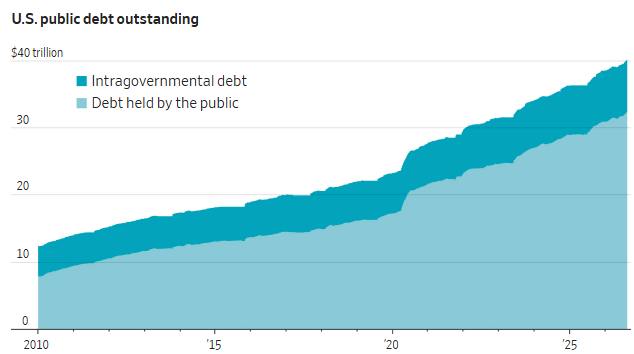
Last week’s announcement that U.S. public debt surpassed $40 trillion renewed investor focus on one of the market’s most persistent long-term concerns: whether rising government debt could eventually put sustained upward pressure on interest rates.
James Carville, who served as President Bill Clinton’s chief strategist during his presidential campaign and as a consultant and sounding board for Clinton during his presidency, once said: “I used to think that if there was reincarnation, I wanted to come back as the president or the pope or as a .400 baseball hitter. But now I would like to come back as the bond market. You can intimidate everybody.”
The question for investors today is whether the “Bond Vigilantes” are beginning to reassert their influence.
Debt Levels on the Rise
Carville’s quote was in reference to challenges the Clinton administration had early in his first term. From October 1993 to November 1994, yields on the 10-year U.S. Treasury bond rose from 5.2% to 8%. The bond market’s reaction was due in large part to spending proposals coming from the new administration and what that would mean for the deficit. Rising yields helped push policymakers toward greater fiscal restraint, and over-time budget deficits narrowed substantially. The U.S. ran a budget surplus from 1998–2001. It was the last time the country did so.
Cumulative U.S. Public Debt
Source: LPL Research, U.S Treasury, The Wall Street Journal 08-21-26
Disclosures: Indexes are unmanaged and cannot be invested in directly. Past performance is no guarantee of future results. Estimates may not develop as predicted and are subject to change.
The “Cumulative U.S. Public Debt” chart illustrates that since the Great Financial Crisis, debt financed spending has increased under all administrations and has accelerated since the Global Pandemic. While $40 trillion is more symbolic than economically significant on its own, it has clearly refocused market attention on U.S. fiscal sustainability.
Treasury Secretary Scott Bessent did comment that the Trump administration is looking for ways to rein in spending. He mentioned this could draw on both increased revenue and decreased spending. However, both of those are difficult items to pursue during an election year. And the bond market is taking notice.
Interest Rates on the Rise
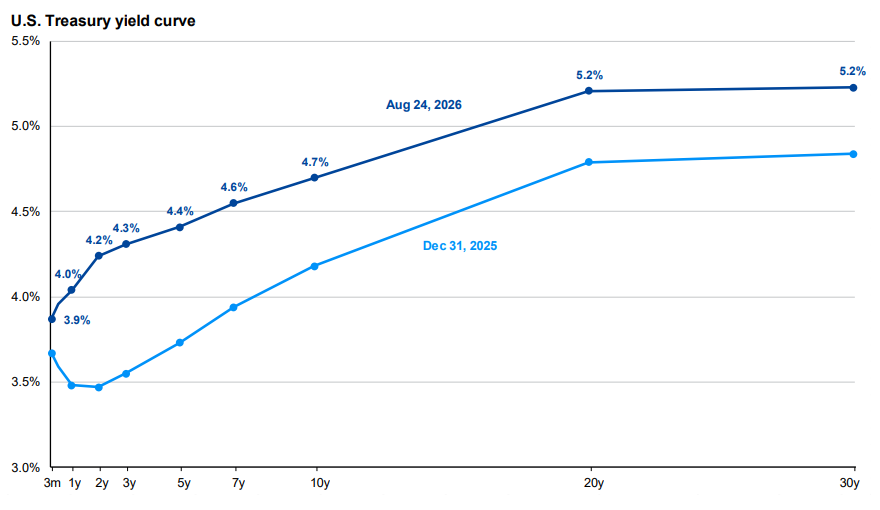
Yields on U.S. Treasury bonds have moved higher throughout the year. There have been several reasons that this has happened, ranging from tariffs to the impact the war in the Middle East has had on crude supply and oil prices to AI company debt issuance crowding out potential investors. Higher Treasury borrowing needs and growing debt-service costs may also be contributing factors behind the rise in longer-term yields.
Yields Moving Higher
Source: LPL Research, FactSet, Federal Reserve, J.P. Morgan Asset Management 8-24-26.
The “Yields Moving Higher” chart highlights that yields on U.S. Treasury notes and bonds have moved higher across the curve from three months to 30 years. The yield on the 30-year U.S. Treasury bond is at levels not seen since 2007. While the drivers are not necessarily the same for each maturity, the results cannot be ignored.
Secretary Bessent noticed this pattern and last week announced that the Treasury Department would intervene in the bond market. He stated that the government would buy long-dated Treasuries on the belief that the market was not reflecting the current fundamentals. These comments could be viewed as somewhat at odds with recent remarks from Federal Reserve (Fed) Chair Kevin Warsh, who recently stated that the bond market was doing some of the work for the Fed by increasing rates and going forward the Fed would turn to markets as a signal in terms of how they think about interest rate policy. This could potentially create confusion and additional uncertainty for investors. But Warsh is about to have his moment in the spotlight tomorrow morning at Jackson Hole.
Kevin Warsh’s Jackson Hole Speech Will Be Closely Watched
The topic of this year’s Jackson Hole Economic Policy Symposium is “Financial Innovation and the Implications for Payments and Policy.” While Chair Warsh’s speech is widely anticipated given that it will be his first at the symposium, it is unlikely that he will break new ground or stray too far from the themes he has previously articulated.
He is unlikely to offer any guidance on near-term policy decisions as he has made it clear that he believes the Fed should offer less guidance, not more. This could lead to a discussion about allowing the market to take its cues from data and not Fed guidance. He is also unlikely to directly criticize last week’s announcement from Secretary Bessent. However, he could address his long-held belief that the Fed’s balance sheet is too big already and any potential plan to shrink it going forward. This would be a subtle nod to the idea that the government shouldn’t be managing bond market yields.
He could certainly lean into the topic of the conference by addressing his views on artificial intelligence and any potential productivity gains that might benefit the economy and influence policy over the long term. This could also be tied into a discussion of the framework that he believes the Fed might use to gauge both short- and long-term inflation indicators.
Previous Warsh post-meeting press conferences have been interpreted as hawkish. Investors are certain to parse whatever he says and implement their views quickly in markets. Given recent volatility in rates, this could also impact equity markets.
Rising Worries Continue to Meet Strong Fundamentals
Investors have become accustomed to navigating a wide range of macroeconomic and policy challenges over the last several years. Risks always exist and now is certainly no different. There are the known risks of tariffs and higher oil prices and how they impact the future path of inflation. These concerns are colliding with new leadership at the Fed and potential changes in how the Fed makes and communicates policy decisions.
The federal deficit and government debt have been on the radar for many years. How and when those issues manifest themselves can’t be timed, as James Carville pointed out many years ago. But the Clinton administration and the Republicans who controlled Congress also showed the problem can be addressed when it becomes a true economic issue. That will likely happen again at some point in the future, but when that occurs is an unknown risk.
While rising debt levels, higher Treasury yields, and evolving Fed leadership warrant close attention, none of these developments alter our fundamental investment outlook. Economic and corporate fundamentals remain supportive; earnings expectations continue to increase, and market leadership is broadening. As a result, we believe a diversified portfolio remains the most effective way to navigate short-term volatility while participating in long-term opportunities.
Important Disclosures
This material is for general information only and is not intended to provide specific advice or recommendations for any individual. There is no assurance that the views or strategies discussed are suitable for all investors. To determine which investment(s) may be appropriate for you, please consult your financial professional prior to investing.
Investing involves risks including possible loss of principal. No investment strategy or risk management technique can guarantee return or eliminate risk.
Indexes are unmanaged and cannot be invested into directly. Index performance is not indicative of the performance of any investment and does not reflect fees, expenses, or sales charges. All performance referenced is historical and is no guarantee of future results.
This material was prepared by LPL Financial, LLC. All information is believed to be from reliable sources; however LPL Financial makes no representation as to its completeness or accuracy.
Unless otherwise stated LPL Financial and the third party persons and firms mentioned are not affiliates of each other and make no representation with respect to each other. Any company names noted herein are for educational purposes only and not an indication of trading intent or a solicitation of their products or services.
Asset Class Disclosures –
International investing involves special risks such as currency fluctuation and political instability and may not be suitable for all investors. These risks are often heightened for investments in emerging markets.
Bonds are subject to market and interest rate risk if sold prior to maturity.
Municipal bonds are subject and market and interest rate risk and potentially capital gains tax if sold prior to maturity. Interest income may be subject to the alternative minimum tax. Municipal bonds are federally tax-free but other state and local taxes may apply.
Preferred stock dividends are paid at the discretion of the issuing company. Preferred stocks are subject to interest rate and credit risk. They may be subject to a call features.
Alternative investments may not be suitable for all investors and involve special risks such as leveraging the investment, potential adverse market forces, regulatory changes and potentially illiquidity. The strategies employed in the management of alternative investments may accelerate the velocity of potential losses.
Mortgage backed securities are subject to credit, default, prepayment, extension, market and interest rate risk.
High yield/junk bonds (grade BB or below) are below investment grade securities, and are subject to higher interest rate, credit, and liquidity risks than those graded BBB and above. They generally should be part of a diversified portfolio for sophisticated investors.
Precious metal investing involves greater fluctuation and potential for losses.
The fast price swings of commodities will result in significant volatility in an investor’s holdings.
This research material has been prepared by LPL Financial LLC.
Not Insured by FDIC/NCUA or Any Other Government Agency | Not Bank/Credit Union Deposits or Obligations | Not Bank/Credit Union Guaranteed | May Lose Value
For Public Use – Tracking: #1165789