China Holds Keys to Post-War Oil Prices
Printer Friendly Version
Key Talking Points
- Global growth remains uneven, with the U.S. economy continuing to outperform while China faces softer demand and a less consistent recovery. For an in-depth outlook, consult the July Economic Navigator.
- China’s sharp decline in crude oil imports has helped offset some of the oil price pressures stemming from Middle East tensions, suggesting demand weakness is currently balancing supply risks.
- U.S. inflation trends are improving, as core consumer inflation continues to moderate, reducing the likelihood of Fed rate hikes in the near term.
- Import prices remain a key inflation risk, with higher costs for industrial supplies, consumer goods, and Chinese imports indicating that some global price pressures are still working through the pipeline.
- The U.S. economy remains well-supported by resilient consumers and strong AI-driven business investment, helping sustain above-trend growth despite geopolitical uncertainty and signs of a gradual cooling in the labor market.
Will Oil Prices Return to Pre-War Levels? It Depends on China’s Economic Growth
One of the key questions for investment professionals is whether oil prices will return to pre-war levels once the Middle East crisis is resolved. Among a variety of factors, one such factor is China demand. The plunge in crude imports caught our attention last month and it’s worth updating the charts for this edition.
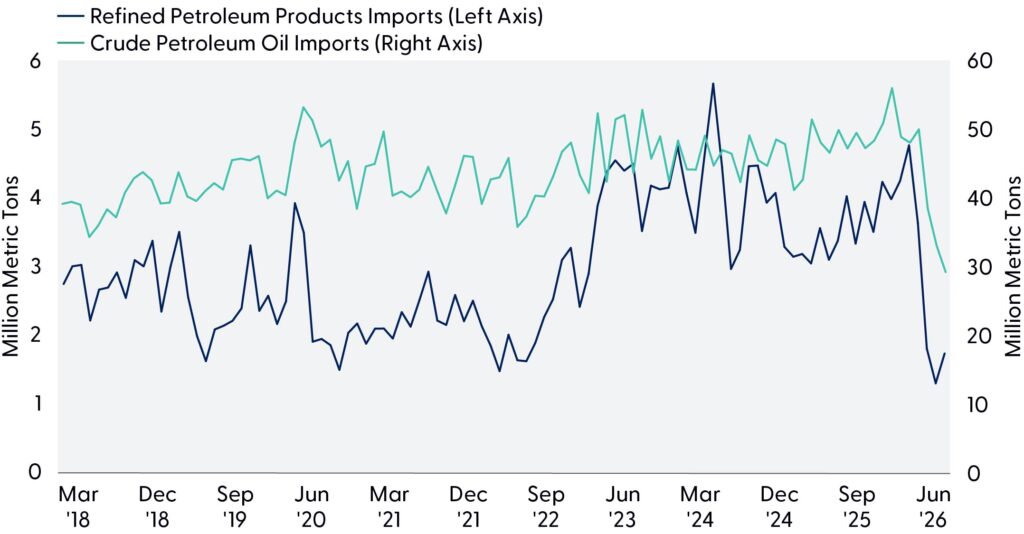
What do we know about China’s economy? China’s June trade data offered another reminder that the country’s growth story remains uneven beneath the surface. Crude oil imports fell sharply, dropping to their lowest level in nearly a decade as geopolitical disruptions in the Persian Gulf collided with softer domestic demand. The decline suggests refiners remain cautious about inventory accumulation, particularly given uncertainty surrounding shipments through the Strait of Hormuz, a critical artery for roughly half of China’s crude imports. While markets continue searching for signs that Beijing may step in to rebuild strategic stockpiles, the latest figures point to a demand backdrop that remains sluggish despite ongoing policy support measures.
Weak Demand from China Cushioned Oil Shock
Source: LPL Research, China General Administration of Customs 07/20/26
Disclosures: Past performance is no guarantee of future results.
The broader energy picture, however, was more nuanced. Natural gas imports climbed to a five-month high and coal imports also surged after mine-safety inspections constrained domestic output following a major accident earlier this year. The divergence between collapsing crude imports and stronger purchases of natural gas and coal highlights an economy that is still grappling with pockets of weak industrial and consumer activity, even as electricity demand reaches record levels during the summer months.
Investors should watch closely for any policy response from Beijing in the second half of the year, particularly if slowing economic momentum pressures officials to accelerate fiscal spending and stabilize domestic demand.
The sharp decline in China’s crude oil imports is potentially more bearish than bullish for the global oil market, at least in the near term. China is the world’s largest crude importer, so the big drop in recent months signals that one of the most important sources of global oil demand is not providing the support many producers were hoping for. If the weakness reflects soft industrial activity, slower transportation demand, and cautious refinery runs rather than temporary logistical disruptions, it reinforces concerns that global demand growth could undershoot expectations in the second half of the year.
That said, there is an important offset. The decline was not solely a demand story. Geopolitical risks in the Persian Gulf and uncertainty surrounding flows through the Strait of Hormuz likely delayed or discouraged some purchases. If trade routes stabilize and Beijing decides to replenish commercial and strategic inventories, imports could rebound sharply in the coming months. In other words, part of the June weakness may represent deferred demand rather than permanently lost demand. Oil traders will be watching closely for signs that Chinese refiners return to the market aggressively, particularly if prices weaken.
From a market-balancing perspective, weaker Chinese imports arrive at an awkward time for producers. OPEC+ has been gradually restoring production, and non-OPEC supply growth remains relatively healthy. If Chinese demand remains subdued while supply continues to increase, the market could move into a larger surplus, placing downward pressure on crude prices. This dynamic would likely cap upside moves in Brent and WTI unless geopolitical disruptions escalate significantly.
For investors, the key takeaway is that the market is currently being pulled in opposite directions. On one side are geopolitical risks that could threaten supply from the Middle East and support a risk premium in oil prices. On the other side is evidence that the world’s largest commodity consumer is experiencing softer demand conditions. Historically, sustained demand weakness from China tends to have a more lasting impact on oil prices than short-lived geopolitical disruptions. As a result, unless China shows signs of rebuilding inventories or stimulating domestic growth, the June import data argues for a more cautious outlook on global oil prices over the medium term.
The Inflation Pipeline is Clogged
June’s Consumer Price Index (CPI) report suggests inflation pressures may be easing, particularly within transportation and medical care services, providing a welcome boost to investor sentiment. Lower energy prices were the primary driver behind the decline in headline inflation, helping the annual CPI rate slow to 3.5%, although recent increases in energy prices could reverse some of that progress in the coming months. Encouragingly, core inflation decelerated to 2.59% year over year, its lowest reading since February, with further improvement likely as durable goods prices continue to soften. While the inflation outlook has become more favorable and reduces the likelihood of near-term Fed rate hikes, geopolitical risks remain elevated. Any renewed energy shock or prolonged supply chain disruption could reignite price pressures, making improvements in global supply conditions and a potential resolution of tensions with Iran increasingly important for sustaining the disinflation trend through year-end.
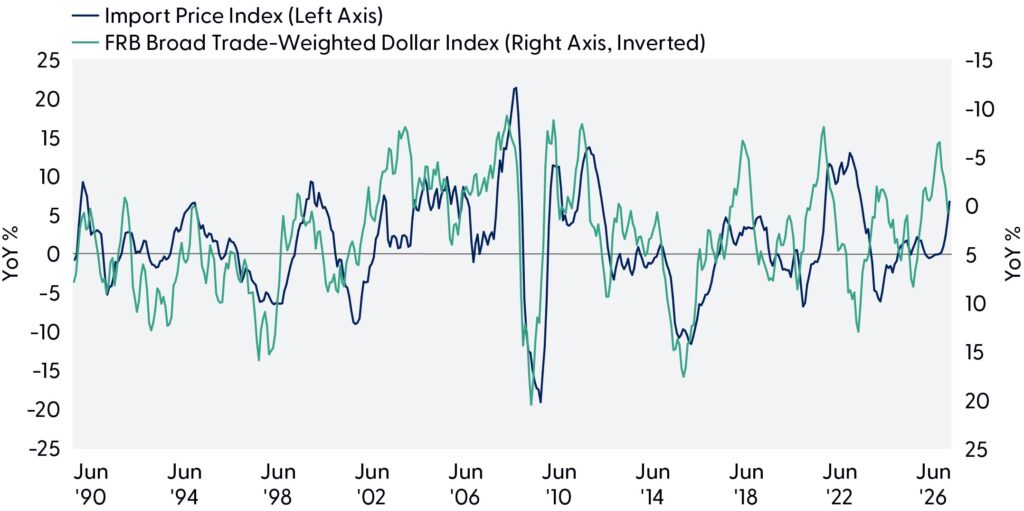
The import price narrative is a bit more nuanced. June’s import price report highlights an important inflation dynamic: despite easing CPI and Producer Price Index (PPI) readings, price pressures at the border remain firm. Import prices rose 0.3% in June and were up 7.1% from a year ago, marking the strongest annual increase in nearly four years. While the surge in AI-related hardware prices moderated after several months of outsized gains, inflation pressures broadened into industrial supplies, consumer goods, and imports from China. Notably, nonfuel industrial supplies posted another strong increase, reflecting higher costs for chemicals, metals, and other production inputs, while consumer goods prices continued to climb for a fifth consecutive month.
A key factor influencing import prices is the U.S. dollar. When the dollar weakens, foreign-produced goods become more expensive for U.S. buyers because more dollars are required to purchase the same amount of foreign currency. The recent rise in import prices, particularly from China and other major trading partners, suggests that currency effects may be amplifying underlying cost pressures from global supply chains and commodity markets. Conversely, a stronger dollar typically acts as a buffer against imported inflation by lowering the effective cost of foreign goods. The June data imply that the dollar has not been strong enough to fully offset rising global input costs and persistent demand for imported products.
We Are Starting to Notice a Breakdown in USD-Import Price Relationship
Source: LPL Research, Bureau of Labor Statistics, Federal Reserve 07/20/26
Disclosures: All indexes are unmanaged and cannot be invested in directly. Past performance is no guarantee of future results.
The bottom line is that import prices remain an underappreciated source of inflation risk. Even as domestic inflation measures show encouraging signs of moderation, sustained increases in import costs could eventually filter through to producer and consumer prices. For investors, the direction of the U.S. dollar will remain an important variable to watch. A firmer dollar could help contain imported inflation, while further dollar weakness would increase the likelihood that higher border costs could continue feeding into broader inflation measures over the second half of the year.
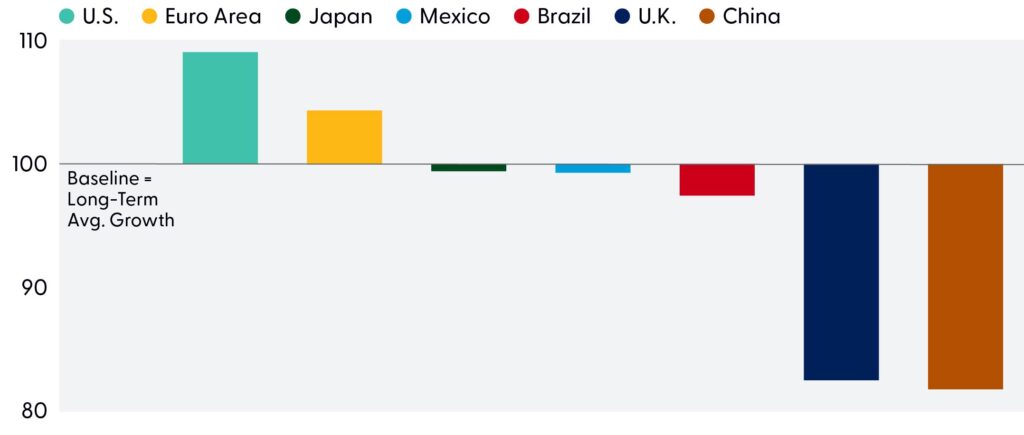
Global Growth Path Expected to Diverge
Despite concerns about tariffs, geopolitical tensions, and periodic market volatility, the U.S. economy continues to demonstrate impressive resilience. Growth appears poised to remain above trend this year, with real gross domestic product (GDP) expected to expand roughly 2.2%, comfortably above the Federal Reserve’s estimate of longer-run potential growth near 1.8%. What’s particularly encouraging is that forward-looking indicators are still signaling expansion. Purchasing manager surveys suggest businesses remain optimistic about future activity, and corporate spending plans have held up far better than many expected. Rather than pulling back amid uncertainty, firms continue to invest aggressively in equipment, technology, and productive capacity.
A major driver behind that strength is the ongoing artificial intelligence (AI) investment cycle. The surge in spending is no longer limited to a handful of large technology companies. We’re seeing broad-based investment across data center construction, semiconductor production, cloud infrastructure, and AI deployment throughout the economy. Businesses increasingly view AI as a competitive necessity rather than an optional upgrade, which helps explain why capital expenditures have remained robust even as borrowing costs remain elevated. The result is an investment environment that continues to support economic growth and productivity gains, providing an important offset to other areas of uncertainty.
The consumer side of the economy also remains on solid footing. Household spending continues to benefit from a labor market that is cooling gradually rather than deteriorating sharply. Job growth has slowed from the exceptionally strong pace seen over the past few years, but employment conditions remain healthy enough to support income and spending. An important factor is the high net worth from financial assets and real estate holdings, which have supported the consumer. We do expect some modest softening ahead, particularly as recent college graduates navigate a more challenging hiring environment and unemployment drifts slightly higher into year-end. Even so, the broader labor market remains fundamentally stable. Meanwhile, inflation pressures that were temporarily boosted by the Iran-related energy shock should ease as those effects fade, helping to improve consumers’ purchasing power and reinforcing the economy’s ability to grow at an above-trend pace.
Source: LPL Research, Nowcasting Economics 07/20/26
Disclosures: All indexes are unmanaged and cannot be invested in directly. Past performance is no guarantee of future results.
Concluding Thoughts
The global growth outlook continues to diverge, with the U.S. economy remaining resilient while China faces softer demand and uneven economic momentum. China’s sharp drop in crude oil imports has helped offset some of the upward pressure on oil prices from Middle East tensions, suggesting that weak demand from the world’s largest oil importer may be a more important driver of prices than temporary supply disruptions. Meanwhile, U.S. inflation data has become more encouraging, as core consumer inflation continues to moderate. However, rising import prices indicate that global cost pressures have not fully disappeared, particularly as higher prices for industrial supplies, consumer goods, and imports from China continue to work through the inflation pipeline.
Against this backdrop, the U.S. economy remains supported by strong business investment, particularly in AI-related technologies, data centers, and digital infrastructure. Consumers are also benefiting from healthy household balance sheets and a labor market that is cooling gradually rather than weakening sharply. While pockets of inflation risk remain and unemployment may drift modestly higher, the combination of above-trend growth, easing inflation, and ongoing investment spending supports a constructive outlook for the U.S. economy in the second half of the year.
Asset Allocation Insights
LPL’s Strategic and Tactical Asset Allocation Committee (STAAC) maintains its recommendation for a tactical equity overweight and fixed income underweight. This reflects an expectation of an eventual long-term easing of geopolitical and commodity supply concerns as a result of the U.S.-Iran conflict, alongside a more cautious outlook for select areas of core fixed income. Overall, our tactical views emphasize a modest equity overweight expressed via a defensive factor tilt, a continued focus on quality bond sectors, caution in rate‑sensitive fixed income sectors, and an ongoing allocation to diversifying strategies and alternatives. Within fixed income sectors, we remain underweight investment-grade corporates and mortgage-backed securities (MBS) as spreads remain tight relative to historical standards, diminishing the risk/reward profile of the sectors.
Important Disclosures
This material is for general information only and is not intended to provide specific advice or recommendations for any individual. There is no assurance that the views or strategies discussed are suitable for all investors or will yield positive outcomes. Investing involves risks including possible loss of principal. Any economic forecasts set forth may not develop as predicted and are subject to change.
References to markets, asset classes, and sectors are generally regarding the corresponding market index. Indexes are unmanaged statistical composites and cannot be invested into directly. Index performance is not indicative of the performance of any investment and do not reflect fees, expenses, or sales charges. All performance referenced is historical and is no guarantee of future results.
Any company names noted herein are for educational purposes only and not an indication of trading intent or a solicitation of their products or services. LPL Financial doesn’t provide research on individual equities.
All information is believed to be from reliable sources; however, LPL Financial makes no representation as to its completeness or accuracy.
All investing involves risk, including possible loss of principal.
US Treasuries may be considered “safe haven” investments but do carry some degree of risk including interest rate, credit, and market risk. Bonds are subject to market and interest rate risk if sold prior to maturity. Bond values will decline as interest rates rise and bonds are subject to availability and change in price.
The Standard & Poor’s 500 Index (S&P500) is a capitalization-weighted index of 500 stocks designed to measure performance of the broad domestic economy through changes in the aggregate market value of 500 stocks representing all major industries.
The PE ratio (price-to-earnings ratio) is a measure of the price paid for a share relative to the annual net income or profit earned by the firm per share. It is a financial ratio used for valuation: a higher PE ratio means that investors are paying more for each unit of net income, so the stock is more expensive compared to one with lower PE ratio.
Earnings per share (EPS) is the portion of a company’s profit allocated to each outstanding share of common stock. EPS serves as an indicator of a company’s profitability. Earnings per share is generally considered to be the single most important variable in determining a share’s price. It is also a major component used to calculate the price-to-earnings valuation ratio.
All index data from FactSet or Bloomberg. All index data from FactSet or Bloomberg.
This research material has been prepared by LPL Financial LLC.
Not Insured by FDIC/NCUA or Any Other Government Agency | Not Bank/Credit Union Guaranteed | Not Bank/Credit Union Deposits or Obligations| May Lose Value
For public use.
Member FINRA/SIPC.
RES-007122-0526 | For Public Use | Tracking #1142231 (Exp. 07/2027)
Source





Weekly Market Commentary | Oil Prices, China, and U.S. Inflation Risks | July 20, 2026
China Holds Keys to Post-War Oil Prices
Printer Friendly Version
Key Talking Points
Will Oil Prices Return to Pre-War Levels? It Depends on China’s Economic Growth
One of the key questions for investment professionals is whether oil prices will return to pre-war levels once the Middle East crisis is resolved. Among a variety of factors, one such factor is China demand. The plunge in crude imports caught our attention last month and it’s worth updating the charts for this edition.
What do we know about China’s economy? China’s June trade data offered another reminder that the country’s growth story remains uneven beneath the surface. Crude oil imports fell sharply, dropping to their lowest level in nearly a decade as geopolitical disruptions in the Persian Gulf collided with softer domestic demand. The decline suggests refiners remain cautious about inventory accumulation, particularly given uncertainty surrounding shipments through the Strait of Hormuz, a critical artery for roughly half of China’s crude imports. While markets continue searching for signs that Beijing may step in to rebuild strategic stockpiles, the latest figures point to a demand backdrop that remains sluggish despite ongoing policy support measures.
Weak Demand from China Cushioned Oil Shock
Source: LPL Research, China General Administration of Customs 07/20/26
Disclosures: Past performance is no guarantee of future results.
The broader energy picture, however, was more nuanced. Natural gas imports climbed to a five-month high and coal imports also surged after mine-safety inspections constrained domestic output following a major accident earlier this year. The divergence between collapsing crude imports and stronger purchases of natural gas and coal highlights an economy that is still grappling with pockets of weak industrial and consumer activity, even as electricity demand reaches record levels during the summer months.
Investors should watch closely for any policy response from Beijing in the second half of the year, particularly if slowing economic momentum pressures officials to accelerate fiscal spending and stabilize domestic demand.
The sharp decline in China’s crude oil imports is potentially more bearish than bullish for the global oil market, at least in the near term. China is the world’s largest crude importer, so the big drop in recent months signals that one of the most important sources of global oil demand is not providing the support many producers were hoping for. If the weakness reflects soft industrial activity, slower transportation demand, and cautious refinery runs rather than temporary logistical disruptions, it reinforces concerns that global demand growth could undershoot expectations in the second half of the year.
That said, there is an important offset. The decline was not solely a demand story. Geopolitical risks in the Persian Gulf and uncertainty surrounding flows through the Strait of Hormuz likely delayed or discouraged some purchases. If trade routes stabilize and Beijing decides to replenish commercial and strategic inventories, imports could rebound sharply in the coming months. In other words, part of the June weakness may represent deferred demand rather than permanently lost demand. Oil traders will be watching closely for signs that Chinese refiners return to the market aggressively, particularly if prices weaken.
From a market-balancing perspective, weaker Chinese imports arrive at an awkward time for producers. OPEC+ has been gradually restoring production, and non-OPEC supply growth remains relatively healthy. If Chinese demand remains subdued while supply continues to increase, the market could move into a larger surplus, placing downward pressure on crude prices. This dynamic would likely cap upside moves in Brent and WTI unless geopolitical disruptions escalate significantly.
For investors, the key takeaway is that the market is currently being pulled in opposite directions. On one side are geopolitical risks that could threaten supply from the Middle East and support a risk premium in oil prices. On the other side is evidence that the world’s largest commodity consumer is experiencing softer demand conditions. Historically, sustained demand weakness from China tends to have a more lasting impact on oil prices than short-lived geopolitical disruptions. As a result, unless China shows signs of rebuilding inventories or stimulating domestic growth, the June import data argues for a more cautious outlook on global oil prices over the medium term.
The Inflation Pipeline is Clogged
June’s Consumer Price Index (CPI) report suggests inflation pressures may be easing, particularly within transportation and medical care services, providing a welcome boost to investor sentiment. Lower energy prices were the primary driver behind the decline in headline inflation, helping the annual CPI rate slow to 3.5%, although recent increases in energy prices could reverse some of that progress in the coming months. Encouragingly, core inflation decelerated to 2.59% year over year, its lowest reading since February, with further improvement likely as durable goods prices continue to soften. While the inflation outlook has become more favorable and reduces the likelihood of near-term Fed rate hikes, geopolitical risks remain elevated. Any renewed energy shock or prolonged supply chain disruption could reignite price pressures, making improvements in global supply conditions and a potential resolution of tensions with Iran increasingly important for sustaining the disinflation trend through year-end.
The import price narrative is a bit more nuanced. June’s import price report highlights an important inflation dynamic: despite easing CPI and Producer Price Index (PPI) readings, price pressures at the border remain firm. Import prices rose 0.3% in June and were up 7.1% from a year ago, marking the strongest annual increase in nearly four years. While the surge in AI-related hardware prices moderated after several months of outsized gains, inflation pressures broadened into industrial supplies, consumer goods, and imports from China. Notably, nonfuel industrial supplies posted another strong increase, reflecting higher costs for chemicals, metals, and other production inputs, while consumer goods prices continued to climb for a fifth consecutive month.
A key factor influencing import prices is the U.S. dollar. When the dollar weakens, foreign-produced goods become more expensive for U.S. buyers because more dollars are required to purchase the same amount of foreign currency. The recent rise in import prices, particularly from China and other major trading partners, suggests that currency effects may be amplifying underlying cost pressures from global supply chains and commodity markets. Conversely, a stronger dollar typically acts as a buffer against imported inflation by lowering the effective cost of foreign goods. The June data imply that the dollar has not been strong enough to fully offset rising global input costs and persistent demand for imported products.
We Are Starting to Notice a Breakdown in USD-Import Price Relationship
Source: LPL Research, Bureau of Labor Statistics, Federal Reserve 07/20/26
Disclosures: All indexes are unmanaged and cannot be invested in directly. Past performance is no guarantee of future results.
The bottom line is that import prices remain an underappreciated source of inflation risk. Even as domestic inflation measures show encouraging signs of moderation, sustained increases in import costs could eventually filter through to producer and consumer prices. For investors, the direction of the U.S. dollar will remain an important variable to watch. A firmer dollar could help contain imported inflation, while further dollar weakness would increase the likelihood that higher border costs could continue feeding into broader inflation measures over the second half of the year.
Global Growth Path Expected to Diverge
Despite concerns about tariffs, geopolitical tensions, and periodic market volatility, the U.S. economy continues to demonstrate impressive resilience. Growth appears poised to remain above trend this year, with real gross domestic product (GDP) expected to expand roughly 2.2%, comfortably above the Federal Reserve’s estimate of longer-run potential growth near 1.8%. What’s particularly encouraging is that forward-looking indicators are still signaling expansion. Purchasing manager surveys suggest businesses remain optimistic about future activity, and corporate spending plans have held up far better than many expected. Rather than pulling back amid uncertainty, firms continue to invest aggressively in equipment, technology, and productive capacity.
A major driver behind that strength is the ongoing artificial intelligence (AI) investment cycle. The surge in spending is no longer limited to a handful of large technology companies. We’re seeing broad-based investment across data center construction, semiconductor production, cloud infrastructure, and AI deployment throughout the economy. Businesses increasingly view AI as a competitive necessity rather than an optional upgrade, which helps explain why capital expenditures have remained robust even as borrowing costs remain elevated. The result is an investment environment that continues to support economic growth and productivity gains, providing an important offset to other areas of uncertainty.
The consumer side of the economy also remains on solid footing. Household spending continues to benefit from a labor market that is cooling gradually rather than deteriorating sharply. Job growth has slowed from the exceptionally strong pace seen over the past few years, but employment conditions remain healthy enough to support income and spending. An important factor is the high net worth from financial assets and real estate holdings, which have supported the consumer. We do expect some modest softening ahead, particularly as recent college graduates navigate a more challenging hiring environment and unemployment drifts slightly higher into year-end. Even so, the broader labor market remains fundamentally stable. Meanwhile, inflation pressures that were temporarily boosted by the Iran-related energy shock should ease as those effects fade, helping to improve consumers’ purchasing power and reinforcing the economy’s ability to grow at an above-trend pace.
Source: LPL Research, Nowcasting Economics 07/20/26
Disclosures: All indexes are unmanaged and cannot be invested in directly. Past performance is no guarantee of future results.
Concluding Thoughts
The global growth outlook continues to diverge, with the U.S. economy remaining resilient while China faces softer demand and uneven economic momentum. China’s sharp drop in crude oil imports has helped offset some of the upward pressure on oil prices from Middle East tensions, suggesting that weak demand from the world’s largest oil importer may be a more important driver of prices than temporary supply disruptions. Meanwhile, U.S. inflation data has become more encouraging, as core consumer inflation continues to moderate. However, rising import prices indicate that global cost pressures have not fully disappeared, particularly as higher prices for industrial supplies, consumer goods, and imports from China continue to work through the inflation pipeline.
Against this backdrop, the U.S. economy remains supported by strong business investment, particularly in AI-related technologies, data centers, and digital infrastructure. Consumers are also benefiting from healthy household balance sheets and a labor market that is cooling gradually rather than weakening sharply. While pockets of inflation risk remain and unemployment may drift modestly higher, the combination of above-trend growth, easing inflation, and ongoing investment spending supports a constructive outlook for the U.S. economy in the second half of the year.
Asset Allocation Insights
LPL’s Strategic and Tactical Asset Allocation Committee (STAAC) maintains its recommendation for a tactical equity overweight and fixed income underweight. This reflects an expectation of an eventual long-term easing of geopolitical and commodity supply concerns as a result of the U.S.-Iran conflict, alongside a more cautious outlook for select areas of core fixed income. Overall, our tactical views emphasize a modest equity overweight expressed via a defensive factor tilt, a continued focus on quality bond sectors, caution in rate‑sensitive fixed income sectors, and an ongoing allocation to diversifying strategies and alternatives. Within fixed income sectors, we remain underweight investment-grade corporates and mortgage-backed securities (MBS) as spreads remain tight relative to historical standards, diminishing the risk/reward profile of the sectors.
Important Disclosures
This material is for general information only and is not intended to provide specific advice or recommendations for any individual. There is no assurance that the views or strategies discussed are suitable for all investors or will yield positive outcomes. Investing involves risks including possible loss of principal. Any economic forecasts set forth may not develop as predicted and are subject to change.
References to markets, asset classes, and sectors are generally regarding the corresponding market index. Indexes are unmanaged statistical composites and cannot be invested into directly. Index performance is not indicative of the performance of any investment and do not reflect fees, expenses, or sales charges. All performance referenced is historical and is no guarantee of future results.
Any company names noted herein are for educational purposes only and not an indication of trading intent or a solicitation of their products or services. LPL Financial doesn’t provide research on individual equities.
All information is believed to be from reliable sources; however, LPL Financial makes no representation as to its completeness or accuracy.
All investing involves risk, including possible loss of principal.
US Treasuries may be considered “safe haven” investments but do carry some degree of risk including interest rate, credit, and market risk. Bonds are subject to market and interest rate risk if sold prior to maturity. Bond values will decline as interest rates rise and bonds are subject to availability and change in price.
The Standard & Poor’s 500 Index (S&P500) is a capitalization-weighted index of 500 stocks designed to measure performance of the broad domestic economy through changes in the aggregate market value of 500 stocks representing all major industries.
The PE ratio (price-to-earnings ratio) is a measure of the price paid for a share relative to the annual net income or profit earned by the firm per share. It is a financial ratio used for valuation: a higher PE ratio means that investors are paying more for each unit of net income, so the stock is more expensive compared to one with lower PE ratio.
Earnings per share (EPS) is the portion of a company’s profit allocated to each outstanding share of common stock. EPS serves as an indicator of a company’s profitability. Earnings per share is generally considered to be the single most important variable in determining a share’s price. It is also a major component used to calculate the price-to-earnings valuation ratio.
All index data from FactSet or Bloomberg. All index data from FactSet or Bloomberg.
This research material has been prepared by LPL Financial LLC.
Not Insured by FDIC/NCUA or Any Other Government Agency | Not Bank/Credit Union Guaranteed | Not Bank/Credit Union Deposits or Obligations| May Lose Value
For public use.
Member FINRA/SIPC.
RES-007122-0526 | For Public Use | Tracking #1142231 (Exp. 07/2027)
Source